
Increased range, higher performance, extended lifetime, lower weight, smaller size, and faster speeds.
37V 13Ah and 52V 13Ah are available. ALL Batteries include a FREE charger!
[74V, 89V, and 104V 13Ah are available by putting 2 batteries below in series. 37V 26Ah and 52V 26Ah are available by putting 2 batteries below in parallel.]
You may also consult with us for custom sized battery packs not listed below.
From batteryuniversity.com:
“The secret of NMC lies in combining nickel and manganese. An analogy of this is table salt, in which the main ingredients of sodium and chloride are toxic on their own but mixing them serves as seasoning salt and food preserver. Nickel is known for its high specific energy but low stability; manganese has the benefit of forming a spinel structure to achieve very low internal resistance but offers a low specific energy. Combining the metals brings out the best in each. NMC is the battery of choice for power tools and powertrains for vehicles. The cathode combination of one-third nickel, one-third manganese and one-third cobalt offers a unique blend that also lowers raw material cost due to reduced cobalt content“
37V 13Ah Ultra High Performance Li-NMC Battery

- Continuous current: 65A (5C)
- Instantaneous current: 100+A (up to 10C)
- Battery Pack size: 7.5" X 4.5" X 3.5"
- Weight: 5.5 lbs
- Cell type: LG 18650 HE2 2500mAh (more information on cell below)
- Cell Combination: 10S5P
- Cycle Life: 750 @ 100% DoD; 1,900 @ 80% DoD
- Free Charger: 2A, 6 hours max charge time
$549.97
*Introductory special until November 31, 201552V 13Ah Ultra High Performance Li-NMC Battery

- Continuous current: 65A or 5C
- Instantaneous current: 100+A up to 10C
- Battery Pack size: 7.5" X 5.1" X 3.5"
- Weight: 7.5 lbs
- Cell type: LG 18650 HE2 2500mAh (more information on cell below)
- Cell Combination: 14S5P
- Cycle Life: 750 @ 100% DoD; 1,900 @ 80% DoD
- Free Charger: 2A (6 hours max charge time)
$679.97
*Introductory special until November 31, 2015
Manufacturer's Description of Cell Used
- Cell Model: LG 18650 HE2
- Nominal Capacity: 2500mAh
- Chemistry: Li[NiMnCo]O2 (H-NMC) / Graphite + SiO
- High Drain- 20A constant current, 35A pulse current load.
- Nominal Voltage: 3.7 V
- Full charge Voltage: 4.2V
- Max Charge Current: 4 amps
- Cycle Life: 750 @ 100% DoD; 1,900 @ 80% DoD
- Positive terminal type: Flat Top
- Diameter 18.3 +0.2/-0.3 mm
- Height 65.0 ± 0.2 mm
- Weight: Approx 45 grams
- Initial Internal Resistance measured in megaOhms with a 1khz AC signal: Specified 15, Actual 12 to 13
- Initial Internal Resistance measured in megaOhms with a DC signal: Specified 30, Actual 21 to 22
Comparing LiFePO4 to LiNMC
In spite of the various chemical variations, lithium-ion batteries can generally be separated into two groups: lithium iron phosphate (LFP, LiFePO4) and metal oxides (NMC, NCA, Cobalt, Manganese). Table 1outlines the differences between LFP and LiNMC chemistry classes on a cell level. The values in the table reflect average values as there is variation in each class.
Table 1: Lithium-ion subcategory comparison
|
LFP |
LiNMC |
|
|---|---|---|
|
Voltage |
3.3 V nominal (2-3.6 V/cell) |
3.7 V nominal (2.7-4.2 V/cell) |
|
Energy Density |
300 Wh/L |
735 Wh/L |
|
Specific Energy |
128 Wh/kg |
256 Wh/kg |
|
Power |
1000 W/kg |
512 W/kg |
|
Cycle Life |
2,000 @ 100% DoD 3,000 @ 80% DoD |
750 @ 100% DoD 1,900 @ 80% DoD |
|
Calendar Life |
6 years |
8 years |
|
Max recommended temperature |
40°C |
55°C |
|
Commercial Suppliers |
A123, Valence, BAK, BYD, K2, Lishen, many Chinese vendors |
Sanyo, Panasonic, Samsung, DowKokam, Sony, LG Chem, Moli |
Important Note Regarding LiNMC Battery Care
All lithium-ion cells are “deep cycle” meaning that they have the ability to be fully charged and discharged. The life of the battery will significantly increase if the depth of each discharge is limited to 80% of the rated capacity.
Comparing lithium-ion to lead acid
Table 2 provides a brief comparison of lead acid to lithium-ion (LiNMC) on a pack level. It should be noted that both chemistries have a wide range of parameter values, so this table is only a simplified representation of a very complex comparison.
Table 2: Battery Technology Comparison
|
Flooded lead acid |
VRLA lead acid |
Lithium-ion (LiNMC) |
|
|
Energy Density (Wh/L) |
80 |
100 |
250 |
|
Specific Energy (Wh/kg) |
30 |
40 |
150 |
|
Regular Maintenance |
Yes |
No |
No |
|
Initial Cost ($/kWh) |
65 |
120 |
600[1] |
|
Cycle Life |
1,200 @ 50% |
1,000 @ 50% DoD |
1,900 @ 80% DoD |
|
Typical state of charge window |
50% |
50% |
80% |
|
Temperature sensitivity |
Degrades significantly above 25°C |
Degrades significantly above 25°C |
Degrades significantly above 45°C |
|
Efficiency |
100% @20-hr rate 80% @4-hr rate 60% @1-hr rate |
100% @20-hr rate 80% @4-hr rate 60% @1-hr rate |
100% @20-hr rate 99% @4-hr rate 92% @1-hr rate |
|
Voltage increments |
2 V |
2 V |
3.7 V |
For a description and comparison of the many different Lithium-ion battery types, visit Battery University:
Desciption of Lithium-ion Batteries at Battery University
Figure 1 (from Battery University) compares the specific energy of lead, nickel- and lithium-based systems.
While NCA is the clear winner by storing more capacity than other systems, this only applies to specific energy. In terms of specific power and thermal stability, Li-manganese and Li-phosphate are superior. Li-titanate may have low capacity but this chemistry outlives most other secondary batteries in terms of life span. It has also the best cold temperature performance. As we move towards electric powertrains, safety and cycle life are becoming more important than capacity alone.
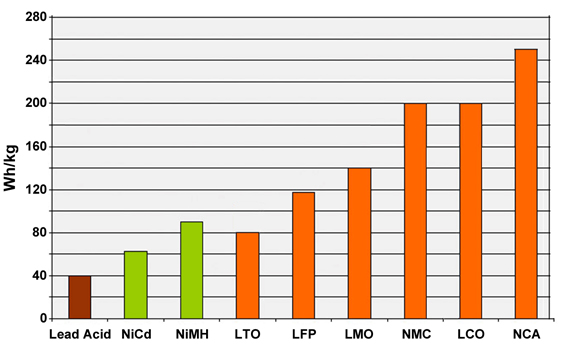
Figure 1: Typical specific energy of lead, nickel- and lithium-based batteries